What shipped
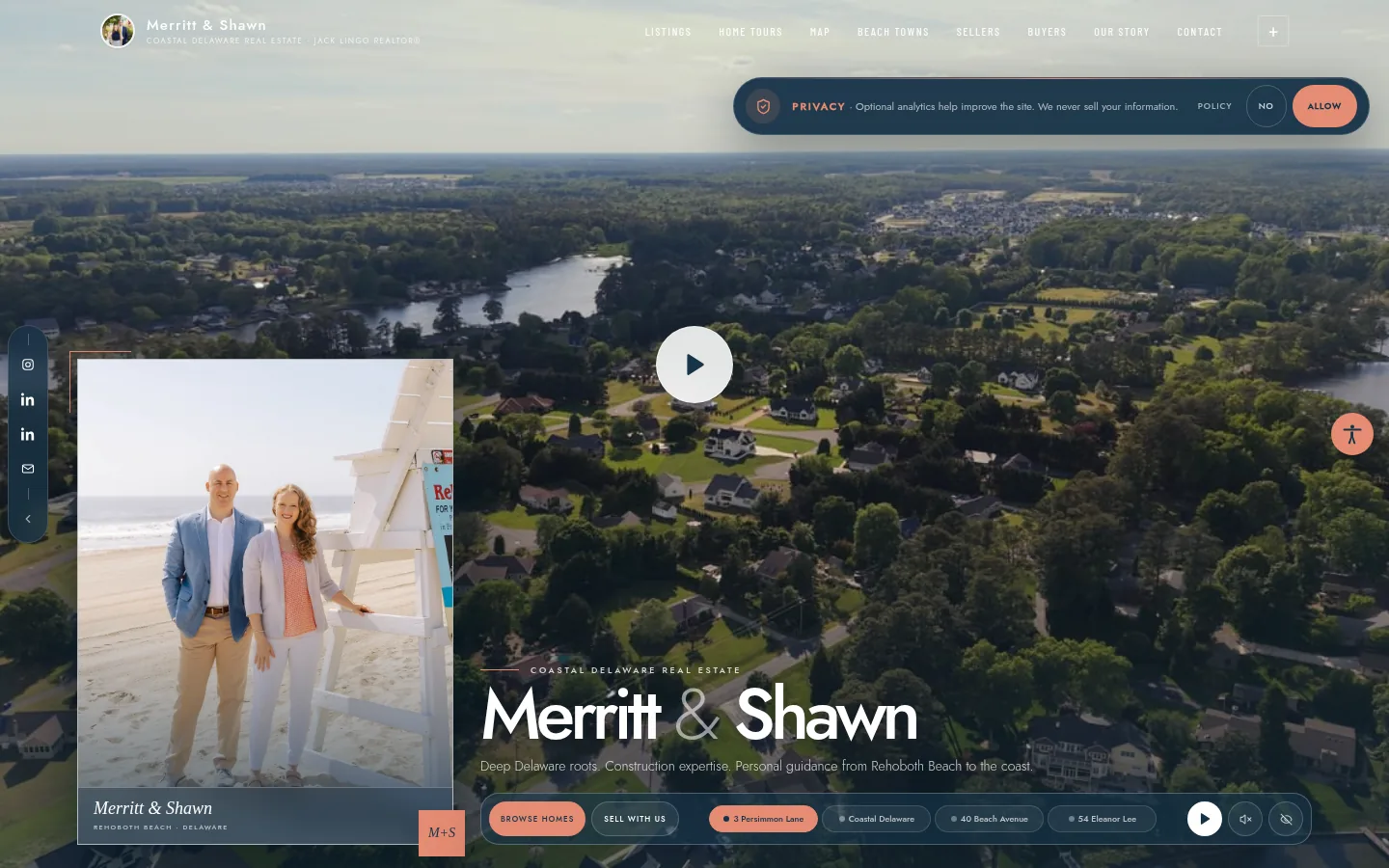
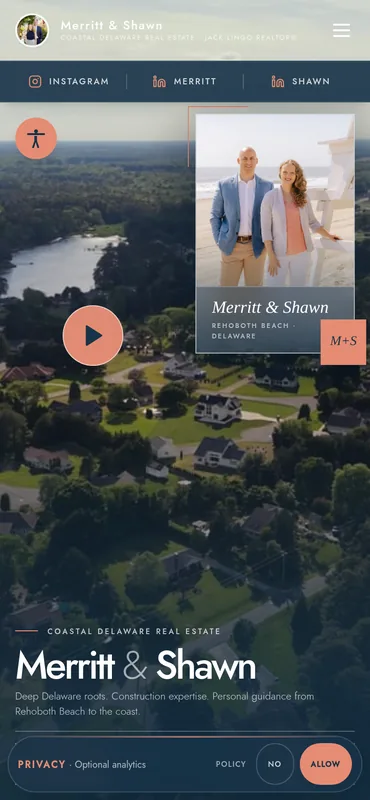
A people-first coastal platform where story, live inventory, six town guides, and property films work together.
- Timeline
- August–September 2026
- Couple-led brand
- Native MLS browser
- Six town guides
- Four property & place films
- Saved search & compare
- Buyer/seller journeys
- Prerendered SEO
The problem
Two agents needed one recognizable public identity without flattening what makes them useful.
The site had to lead with Merritt and Shawn’s partnership while preserving brokerage disclosures, live inventory, local search structure, buyer and seller paths, and the practical detail expected from a coastal property platform.
It also needed cinematic property media that felt intentional, not an autoplay layer fighting the rest of the page.
Six towns, six original buying contexts
Lewes, Rehoboth, Dewey, Bethany, Fenwick Island, and Milton each have their own neighborhoods, lifestyle sections, buyer cautions, FAQs, map center, and geographic schema. The content addresses walkability, seasonality, rental rules, flood exposure, parking, and year-round character rather than swapping town names into one template.
The people come before the brokerage template
A bright coastal system, client-approved couple imagery, press and review context, and a shared origin story establish Merritt and Shawn first. Brokerage affiliation stays clear without becoming the entire identity.
Story, search, and film stay under visitor control
The listing browser combines six beach-town jump points, map/list views, URL-synced filters, favorites, saved searches, an own-listings isolate, three-home comparison, inquiry flows, and a mobile bottom sheet.
Three Vimeo property tours and one full coastal drone film open in a focus-managed viewer with explicit play, sound, full-film, Escape, and keyboard behavior. Media adds context without taking control away from the visitor.
- Own listings are visibly distinctbecause the team’s inventory can stand out without hiding the rest of the market.
- Filters survive in the URLbecause a useful search should be shareable and returnable.
- Town pages open a pre-centered mapbecause local research should flow directly into relevant inventory.
One manifest guards every public route
A 17-route typed manifest drives both Playwright prerendering and sitemap output. Each route receives a title, description, canonical, social card, JSON-LD, and optional LCP preload; the build rejects duplicate titles, missing canonicals, bad social metadata, and invalid structured data.
A React app delivered as crawlable documents
Vite and React Router build the application, then Playwright renders every manifest route to static HTML for Cloudflare Pages. A dedicated worker supplies Bright MLS data while Leaflet, marker clustering, Vimeo, R2 video, and optional GA4 handle maps, media, and measurement.
The browser uses debounced bounds requests, stale-response guards, persisted user choices, and synchronized card/pin state so a data-heavy interface remains usable on a phone.
Real screens, not mockups.
What shipped
These are source-backed product and build figures. Business results, transaction volume, and lead outcomes belong to the client and are not claimed here.
The brand earns attention; the product answers the next question
The couple-led story, local films, live listings, original area pages, buyer and seller journeys, and direct inquiry actions form one coherent route from recognition to a property-specific conversation.
Have a problem that looks like this?
That's the kind of gap I close. Tell me what's breaking and I'll show you the system that fixes it.