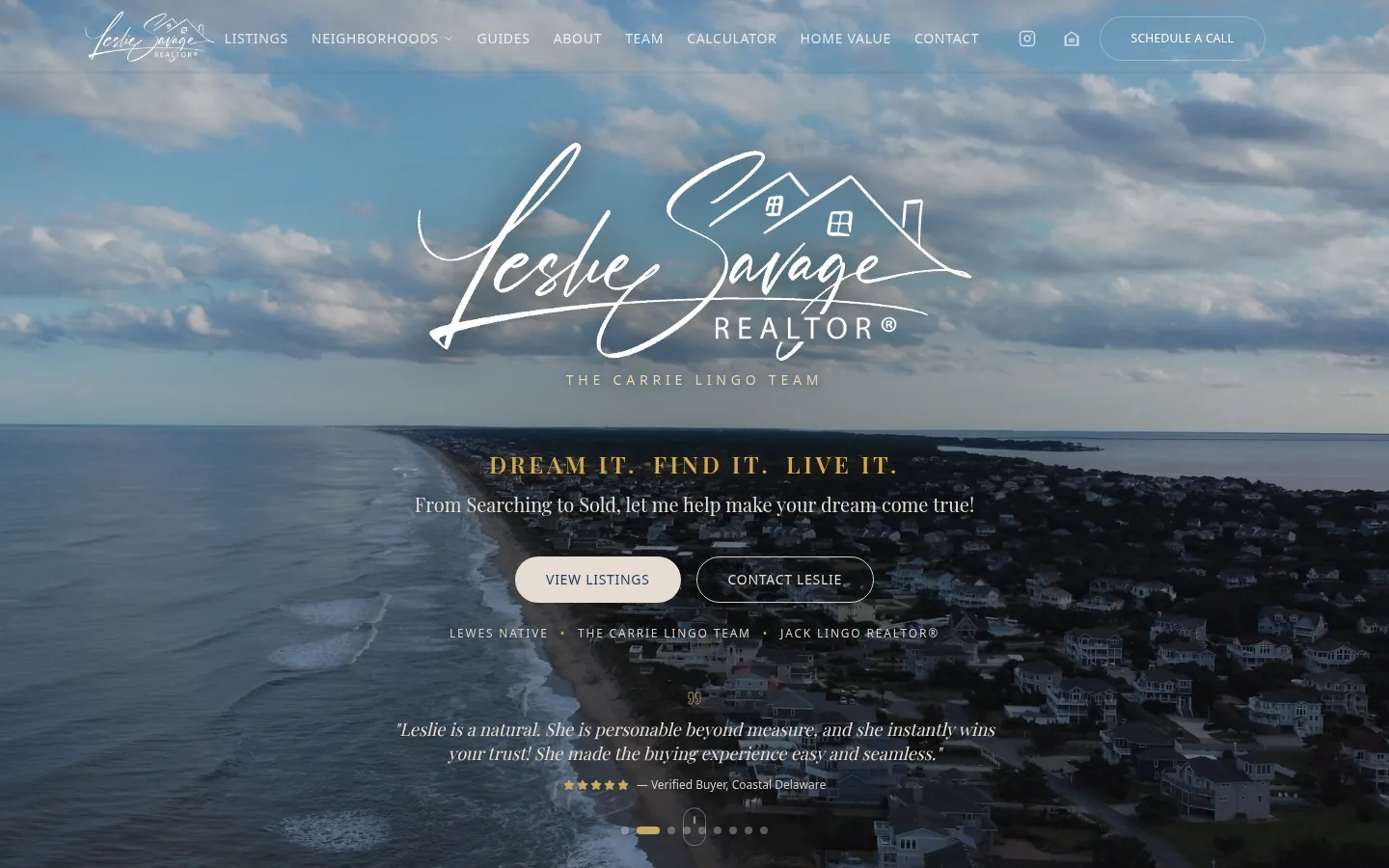
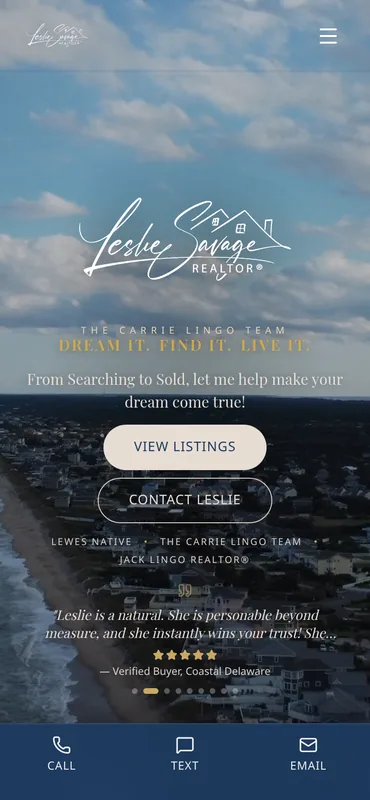
What shipped
A coastal property platform with live inventory, 195 built pages, and decision tools before the sales call.
- Timeline
- January–September 2026
- Native MLS browser
- 86-community library
- Neighborhood matcher
- Four calculators
- Saved homes & searches
- Lead forms
- Worker-fed inventory
The problem
A brochure site could not answer the questions coastal buyers ask before they choose an agent.
The build needed live inventory, local context, affordability math, saved state, and clear inquiry paths while remaining a fast static export with no Next.js server runtime.
Jack Lingo’s listing endpoints also block ordinary browser access, so the native search needed a same-origin data layer rather than an iframe as its primary experience.
Turn local knowledge into structured decisions
The source models 86 Sussex County communities with location, price range, character, categories, amenities, highlights, and map coordinates. A five-part matcher scores that library against budget, lifestyle, atmosphere, amenities, and preferred town.
Nine curated search presets and four calculators cover the next practical questions: mortgage payment, seller proceeds, Delaware transfer tax, and beach-rental income.
Search built for the phone in a buyer’s hand
The native browser keeps map pins and listing cards synchronized, sends filters upstream, protects against stale responses, supports town jumps and URL-linked searches, and keeps existing pins visible while fresh results arrive.
Buyers can filter by monthly payment, save homes and searches locally, compare three properties side by side, open a listing inquiry, and use a drag-controlled mobile bottom sheet that stays above the persistent contact bar.
- Map and list share selectionbecause the same home stays clear whether the buyer starts with its price pin or card.
- Monthly payment is a first-class filterbecause many buyers know the monthly ceiling before they know a list-price ceiling.
- Saved state needs no accountbecause favorites and searches remain useful without adding a personal-data warehouse.
Static depth with live inventory
The build produces 195 static pages, including community routes and original guides, with canonical and social metadata, sitemaps, listing and article schema, neighborhood share cards, crawlable sold-listing context, and a finance-application schema for the calculators.
Static pages, worker-fed data
Next.js exports the public experience for a Cloudflare Worker to serve. The worker proxies live Jack Lingo and Bright MLS marker and listing endpoints, applies sales-specific filters, caches responses, and refreshes a KV listing feed every two hours.
Leaflet and marker clustering handle the map; browser storage owns favorites and saved searches; Web3Forms handles inquiries. The same mortgage module drives both the calculator and monthly-payment filters so the math cannot drift between surfaces.
Real screens, not mockups.
What shipped
These are source-backed build outputs and product surfaces. Traffic, transactions, and lead results belong to the client and are not claimed here.
Content and inventory lead to one next step
Community research, neighborhood matching, calculators, live listings, favorites, comparisons, and inquiry actions let a buyer move from ‘where should I look?’ to a specific property and conversation without leaving the agent’s site.
Have a problem that looks like this?
That's the kind of gap I close. Tell me what's breaking and I'll show you the system that fixes it.